

If you work in radiology, you surely know what a "good X-ray door" means. You can distinguish between doors that are unremarkable and unobtrusive, and those that become increasingly irritating with each passing hour. There are always hidden values behind these impressions. Something as simple as a door, yet crucial, can either support or sabotage:
-
operational efficiency,
-
patient and staff safety,
-
risk control,
-
accessibility and comfort,
-
efficient handling of high patient turnover,
-
stability and reliability without surprises,
-
integration with the hospital automation system.
Which X-ray doors meet a serious list of requirements?
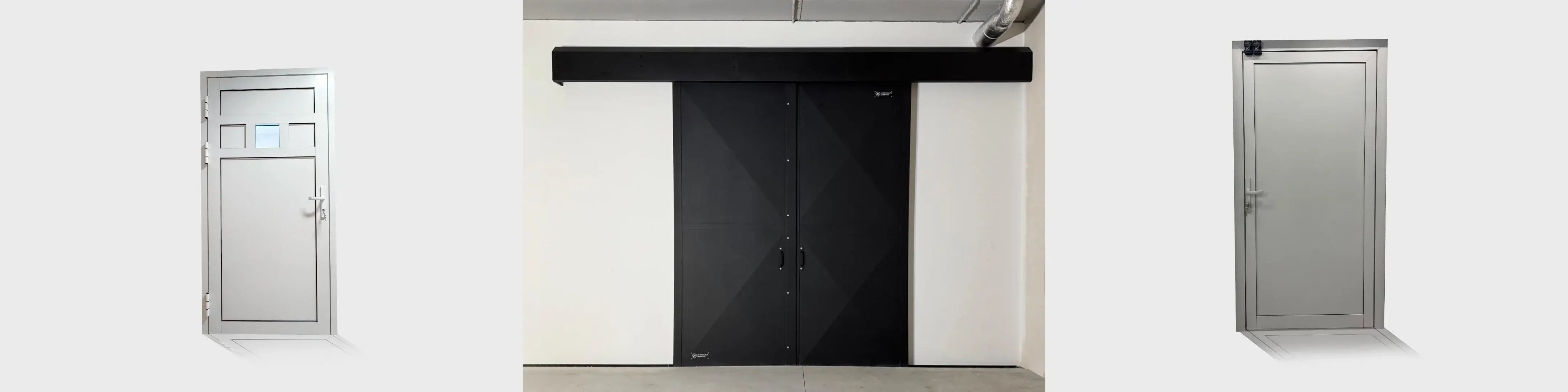
Sliding doors are a technology designed for X-ray offices and labs with high turnover and a high workload. From the moment they enter, they dictate the highest standards, discipline, consistency, and efficiency, where dozens of patients a day are the norm, sometimes reaching triple-digit results. X-ray doors are a declaration that both the first and the hundredth patient undergo identical procedures without compromise.
We've known this for a long time, so the technology of sliding X-ray doors—their production and installation—holds no secrets from us. We develop these solutions with professional, modern offices in mind, where busy radiologists don't have time to deal with malfunctions or shielding discontinuity signals.
In such environments, there's no need to constantly back up, walk around the wing, or avoid collisions with equipment or the patient. Whether the patient is younger or older, post-operative, or wheelchair-bound, they should experience the highest standard of care while minimizing psychological barriers.
Doors that take care of your security
Because it's easier to install electronics in sliding doors in X-ray rooms than in swing doors, professionally secured automation mechanisms with actuators for automatic opening and closing are often installed. This is perfectly combined with closure control solutions that increase the level of security – because with triple-digit rotation, any minor oversight throughout the day is scaled many times more severely than in a small private X-ray room.
X-ray doors as a response to sanitary and operational pressure
If we're discussing automation mechanisms and the nature of sliding technology itself after 2019, epidemiological safety must be mentioned. Sliding X-ray doors significantly reduce contact surfaces, improving hygiene and limiting the risk of infection, which is highly justified in both public hospitals and private clinics that prioritize patient care.
We live in a world where X-ray doors are no longer simply interior design elements intended to fit into the design of a radiological shield. Behind each door are specific intentions for radiological protection, in symbiosis with physical safety, ergonomics, psychological comfort, efficiency, and reliability.
How to compare the reliability of X-ray sliding doors with swing doors?
It may seem that a complicated structure with guides and automation, plus challenges related to weight and interference with the wall, are pitfalls related to failure and leaks that are difficult to predict for the average user.
In fact, in large diagnostic centers, it's the swing doors that pose the risk of technical problems. The increased weight, due to the uncompromisingly required lead layer, the frequency of opening and closing, the susceptibility to impact, and the usually limited number of hinges, all create a recipe for unforeseen problems, with the following factors playing a key role:
-
wing droop,
-
cracked door frame,
-
deformations affecting the continuity of shielding,
-
challenges when it comes to installing electronics.
If your X-ray room door is slowly becoming the weakest link in your fixed shielding system:
Consult your situation with our patient and competent sales department [ Contact ]
See the X-ray sliding doors installed by us [ Facebook ]
See how efficient our team is [ Instagram ]
Discuss with us professionally [ LinkedIn ]
See our original X-ray sliding doors manufactured at JS-METALS [ link ]
Share:
X-ray protection audit and the cat case