

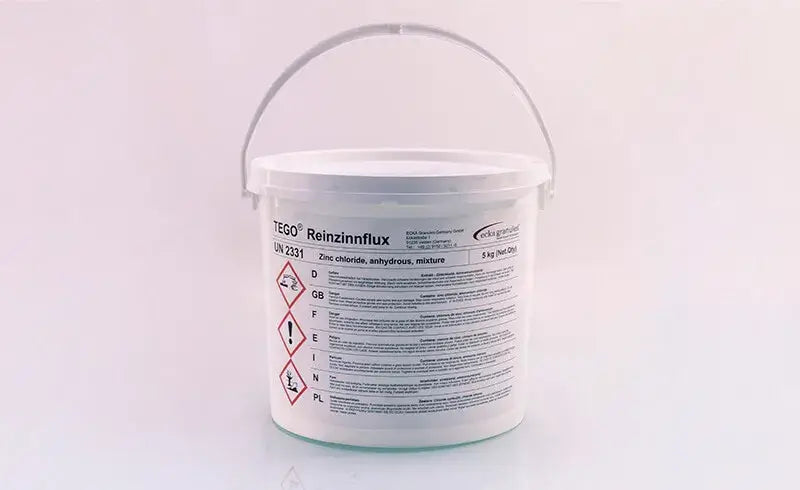
TEGO® Reinzinnflux - Tinning of bearing shells
Couldn't load pickup availability
Pickup available at Biuro JS-METALS
Usually ready in 24 hours How to achieve a good bond between the metal (bearing alloy) and the bearing base?
The key to success is the even tinning of the bearing shell.
For effective tinning of the bonding surface of bearing shells made of steel, cast iron and bronze, we recommend TEGO® Reinzinnflux.
Pairs well with
Shipping within 48 hours
Quality guarantee
Delivery at the best price
The price includes TAX
TEGO® Reinzinnflux - Tinning of bearing shells
If you have any questions, please contact us. We will respond as quickly as possible, within 24 hours on weekdays.
-
Shipping Information
Shipping costs depend on the weight and size of the package. We offer both parcel and pallet shipping. For more information, see the "Shipping Policy" link at the bottom of the page.
-
FAQs
Check out our knowledge base where you will also find a section with frequently asked questions.
-
Contact us
If you have any questions, please contact us. We'll be happy to help you choose.
Why?
– TEGO® Reinzinnflux is a mixture of pure tin powder (lead-free) with a highly active flux .
– It has a high tin content.
– It's economical : 1.0 kg of TEGO® Reinzinnflux can achieve 6-7 m² of bonding surface. It's supplied as a powder in 5 kg buckets.
Simple Instructions
When using TEGO® Reinzinnflux, wear a face shield and gloves. Surfaces to be tinned must be metallically clean. For more information, please refer to the material safety data sheet.
1. Before processing TEGO® Reinzinnflux: Using a brush, activate the bonding surface of the steel bearing with a coating of TEGO® Lötwasser (TEGO® Roptin is omitted in this case).
2. Mix TEGO® Reinzinnflux with water to obtain a paste for application with a brush.
3. Apply a uniform, thin layer of paste to the bearing shell.
4. Heat the bearing housing until a uniform, silvery surface is achieved. The paste melts at approximately 240°C.
5. Remove the remaining flux with water.
The bearing shell is now ready for pouring with bearing alloy using either the centrifugal or spin method. It now simply needs to be reheated to the required casting temperature.